DSCC Statement Congratulating Senator-Elect Peltola
Punchbowl News: “The brutal 2026 map didn’t matter in the end. Democrats capitalized on President Donald Trump’s unpopularity and voters’ affordability concerns, plus several recruiting coups, to decimate Republicans”
New York Times: “There’s simply no modern precedent for either party to do so well in states that had leaned so heavily toward the other side”
DSCC Chair Sen. Kirsten Gillibrand on CNN: “It’s a tsunami. That’s what’s bigger than a wave. It was an incredible night. People voted for change”
Senate Democrats delivered a “herculean” performance to overcome a “brutal” map and a historic financial disadvantage – producing midterm results with “no modern precedent” and the “largest victory by either party in half a century,” with the opportunity for further gains as votes continue to be tabulated in Mississippi and Alaska.
It has been 50 years since one party “won more than two seats that leaned toward the other party in the last presidential election by more than 10 points. Democrats have won five and could win seven.” Democrats were able to “decimate Republicans” thanks in large part to “several recruiting coups” and a crop of candidates who “knew how to tailor their message to the states,” were laser-focused on pushing back against “high gas prices, an unpopular war in Iran and stubbornly high inflation,” and offered “a decidedly different brand of politics.”
Democrats’ “new generation of rising stars captured the country’s attention” and won back “key blocs of the voters that brought Mr. Trump back to power,” including “Hispanics, voters under 30, and working-class whites without college degrees.” The “brutal 2026 map didn’t matter in the end,” and the result is a “generational remake of the Senate map” that could lock Republicans “out of the majority for multiple cycles.”
See for yourself:
New York Times: There’s No Modern Precedent for This Democratic Tsunami
- At the beginning of this year’s midterm campaign, it seemed that everything would have to go right for Democrats to win the Senate.
- On Tuesday, everything went right for Democrats, and more.
- This was an electoral tsunami: a complete collapse of the Republican coalition and the largest victory by either party in half a century.
- When all the vote is in and counted, Democrats will win the national popular vote in all House races combined by 13 percentage points, according to our estimates. That would be the largest margin of victory since the post-Watergate elections in 1974 and 1976.
- And by one measure, it’s even larger: Democrats could flip as many as seven Senate seats that leaned Republican by more than 10 points in the previous presidential election.
- There’s simply no modern precedent for either party to do so well in states that had leaned so heavily toward the other side.

- For good measure, the Democrats didn’t just win in any red states — they won in Texas and Kansas, two states that have epitomized the Republican hold on the heartland for a generation. And they didn’t just eke out victories — they won big, including by double digits in Texas.
- It was hard to imagine that this kind of tsunami was still possible in this polarized era of American politics. But while all of the close election results over the last few decades have given the impression that America’s political divides are intractable, there have been extraordinary changes just beneath the surface.
- And the Democratic breakthroughs in traditionally Republican areas, from Wichita, Kan., to Greenville, S.C., were possible only because a crucial sliver of Republican-leaning voters decided to vote for Democrats. They may have been skeptical of Mr. Trump all along, but they always voted for him and his party. This time, they did not.
NPR: Chuck Schumer heralds Democrats’ ‘generational remake’ of Senate
- Senate Minority Leader Chuck Schumer told reporters Wednesday that the massive blue wave that brought Democrats control of the House and Senate signifies a “generational remake of the Senate map.”
- “These voters did not give us the majority so we can do whatever we want,” the New York Democrat said outside the Democratic Senatorial Campaign Committee in Washington, D.C. “They entrusted us with the majority to do what they — the American people — want.”
- Democrats secured major gains in red states President Trump has previously carried, including Iowa, Ohio, South Carolina and Texas. Their victories include a history-making win in Kansas, which hasn’t sent a Democrat to the Senate in 94 years.
- Schumer, who is poised to become Senate Majority leader in January, credited these wins to a crop of candidates who “knew how to tailor their message to the states.”
- Democrats now have a 54-seat majority, including the two independent senators who caucus with the party. Two races have still not been called: Alaska and Mississippi.
- Schumer vowed that “relief is on the way” for voters, and acknowledged that some remain skeptical that Democrats will deliver. He said Democrats are intent on bringing down the cost of living, ending the Iran war, and undertaking investigations into the White House to address allegations of corruption.
- “The days of Trump’s supplicant Senate are over,” Schumer declared.
CNN: Democrats Celebrate Stunning Sweep to Power in New Congress

- DSCC Chair Sen. KIRSTEN GILLIBRAND: It’s incredible. And an answer to your colleague’s question. It’s a blue tsunami. It’s a tsunami. That’s what’s bigger than a wave.
- It was an incredible night. People voted for change. They are fed up with Trump’s America. They don’t like the high cost of gasoline and heating fuel. They don’t like the high cost of groceries and housing, and they want access to better health care. They want things to be better than it is.
- President Trump promised no forever wars. We’re mired in this war in Iran. President Trump has delivered so much corruption to Washington; he’s much more focused on his ballrooms and tax breaks for billionaires and bombs for his war than actually getting people the health care they need to survive.
- And so people voted for change. And it was a blue tsunami.
New York Times: The 7 States That Flipped and Broke Republican Control of the Senate

- Democrats seized control of the Senate on Tuesday in a sweeping repudiation of President Trump just two years after his triumphant return to Washington.
- Propelled by concerns over affordability and broad dissatisfaction with the president, the Democrats flipped at least seven Senate seats in a map that was daunting for the party, according to results tallied as of early Wednesday morning.
- Most of the seats had not elected a Democrat to the Senate since former President Barack Obama was elected in 2008. For Kansas, it has been almost a century.
- The resurgence penetrated states long thought of as bedrocks of conservatism, with Democrats pulling off unexpected upsets in Kansas and South Carolina and clinching Texas, which until Tuesday had been the nation’s most populous conservative state and a symbolic center for the Republican Party.
- Among the most significant takeaways from this year’s midterm elections was just how much has changed in two years. In this divided era, only a sliver of the electorate had appeared open in recent elections to crossing party lines. On Tuesday, that presumption was largely shattered. Five states that voted for Mr. Trump by more than 10 points in 2024 instead opted for Democrats.
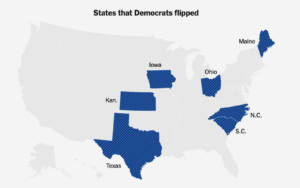
- Republicans lost key blocs of the voters that brought Mr. Trump back to power just two years ago. Across the seven states that flipped, the voters that moved significantly toward Democrats included Hispanics, voters under 30, and working-class whites without college degrees, according to Times Voter Trends.

- The Democrats have not had a Senate majority of this size since 2014, when the party controlled 55 seats.
Punchbowl News: Chuck Schumer’s big moment — and John Thune’s plans
- A year ago, Chuck Schumer predicted Democrats would win the Senate this November. At the time, it looked like wishful thinking […]
- Democrats flipped the majority on Tuesday, a once-unfathomable outcome in a cycle stacked against them. Schumer – who turns 76 in a few weeks – may never have been in real danger of losing his leadership post. But he’s riding high this morning on his way to a second stint as majority leader. Winning back the Senate was, as Schumer often put it, his “north star.”
- “The American people reduced the red brick wall to a pile of bricks, and as a result, there is now a generational remake of the Senate map that is going to change America now and on into the future,” Schumer said late Tuesday night.
- A few races are still too close to call, but a 56-seat majority isn’t out of the question. The brutal 2026 map didn’t matter in the end. Democrats capitalized on President Donald Trump’s unpopularity and voters’ affordability concerns, plus several recruiting coups, to decimate Republicans.
- Immediate fallout. Republicans could be locked out of the majority for multiple cycles.
New York Times: How a Blue Wave Became a Red Wipeout
- In the end, it wasn’t just a wave. It was a wipeout.
- A Democrat won a Senate seat in Kansas for the first time since the Herbert Hoover administration. The party picked up Senate seats in Texas, North Carolina and South Carolina.
- The sweeping Democratic victories on Tuesday night offered a decisive rebuke to President Trump and his aggressive, often chaotic second-term agenda.
- The party seized control of both houses of Congress. Voters rejected Republicans in conservative states that supported Mr. Trump by double-digit margins just two years ago, in places that had not seen competitive elections for major seats in decades.
- Even some Democrats were stunned by the extent of their wins, which included defeating Greg Abbott, the three-term Republican governor of Texas; and Susan Collins, the five-term Republican senator from Maine.
- “It’s a blood bath,” said Dan Sena, who was the executive director of the Democratic Congressional Campaign Committee during the last Democratic wave, in 2018. “Democrats are going to be in power in places they haven’t been in power in decades.”
- And so the era of one-party rule in Washington ended with a crash, as voters pushed back on high gas prices, an unpopular war in Iran and stubbornly high inflation. As Wednesday dawned, there were signs that the country was entering a new and uncertain political time, in which both parties would be forced to consider how to navigate a post-Trump political era.
- While Democrats have not solved all the problems that cost them the 2024 election, their wins were a powerful sign of renewal as a new generation of rising stars captured the country’s attention.
- In many states, Democrats ran candidates who offered a decidedly different brand of politics from the “resistance” ethos that characterized their response to Mr. Trump’s first term.
- Instead, they focused their message on the deep economic anxiety that has roiled the country, arguing that the president and his Republican allies were enriching themselves while ordinary Americans struggled. Survey after survey showed a majority of voters, and a notable share of Republicans, offering low marks to his signature policies: tariffs, immigration enforcement and the Iran war.
Latest News
VICTORY LAP: Democratic Senators-Elect Take to the Airwaves in Post-Midterm Blitz
VICTORY LAP: Democratic Senators-Elect Take to the Airwaves in Post-Midterm Blitz

