DSCC Statement Congratulating Senator-Elect Peltola
January 14, 2026
TO: Interested Parties
FR: Devan Barber, DSCC Executive Director
RE: Senate Democrats Carve Out Path to Senate Majority in 2026
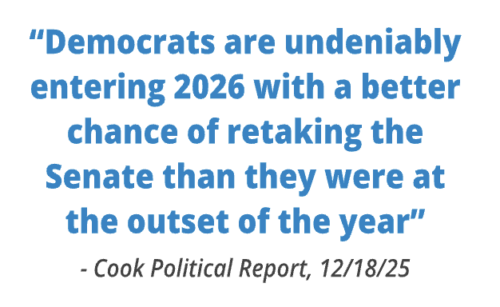
Over the last year, the Democratic Senatorial Campaign Committee (DSCC) has built a strong foundation for electoral success and created the path for Democrats to take the Senate majority in 2026. While Republicans began the cycle pledging to grow their ranks in the Senate to 55 seats, it is now clear that not only will they fail to meet that goal, but that they also face a serious threat to holding their majority at all. This dynamic did not emerge overnight, and is driven by disciplined strategies Democrats employed in 2025 to:
- Recruit strong Democratic candidates across the country, puttingRepublicans on defense and creating multiple paths to a Democratic Senate majority.
- Discourage formidable Republican candidates from entering Senate races, and highlighting the damaging and expensive GOP primaries –putting more races in play.
- Relentlessly focus on the issues that matter to voters, and hold Republican candidates accountable for failing to address them.
Senate Democrats Expanded the Battleground Map and Created Multiple Paths to the Majority
At the start of 2025, Democrats had two clear offensive targets: Maine and North Carolina. Over the past year, the DSCC expanded the battleground map significantly and created multiple potential paths to the majority with “star recruits in marquee races” and formidable Democratic campaigns.
- In Alaska, Mary Peltola entered the race against Dan Sullivan as “the only person who could pose a threat to Senator Dan Sullivan” and her decision to run for Senate is a “big boost” for Democrats and the “final puzzle piece Democrats need to pull off an upset.” Early polling shows the race statistically tied, with most polls showing Peltola – who is the most popular public figure in Alaska – with a slight lead over Sullivan.
- In Iowa, Joni Ernst’s decision to retire despite an “intense intraparty effort to persuade her to run again” put “a competitive Senate seat in play” and came amid “recent signs of political headwinds for Republicans in Iowa.” The upcoming election will be the first time in more than 60 years that Iowa has had an open Senate seat and an open gubernatorial seat at the top of the ticket at the same time, and Democrats massively overperformed in three special elections last year.
- In Maine, Governor Janet Mills’ entrance into the Senate race prompted analysts to immediately shift the race in Democrats’ favor, noting her candidacy marks a “significant escalation in political firepower” in the race against Susan Collins. Mills is the only Democrat to have won statewide in Maine in the last 20 years and has consistently overperformed other Democrats in dense areas, suburbs, and rural communities. Susan Collins’ numbers have declined precipitously since 2020, and she is at a much worse position with Maine voters now than she was at this point in the 2020 cycle.
- In Michigan, Republicans are stuck with flawed candidate Mike Rogers after he underperformed Trump by over 100,000 votes in 2024 and lost in a wave Republican year as Trump carried the state. Michigan Republicans blame Rogers’ loss on “candidate quality,” saying he “didn’t resonate with people.” Rogers’ lackluster fundraising has continued this cycle, lagging behind the Democratic candidates and resurfacing “a major concern many Republicans had during his race last cycle.”
- In New Hampshire, Chris Pappas is a “formidable candidate” and “a strong favorite to win in a general election.” Pappas has a record of winning tough races in New Hampshire, and he maintains a lead against both of his potential Republican opponents in early polling.
- In North Carolina, former Governor Roy Cooper is a “heavyweight candidate” with “a record of winning over Republican voters and running disciplined campaigns,” and his decision to run for Senate marked a “significant boost” for Democrats. Cooper has never lost an election and has already built a formidable campaign, “shattering records,” dramatically outraising his opponent, and maintaining a tight lead in early polls.
- In Ohio, Sherrod Brown’s decision to run for Senate “puts the Ohio Senate special election on the competitive map.” Brown is the only Democrat to win a statewide race in Ohio in nearly 20 years, and in 2024, he overperformed the top of the ticket by more than 7 points. Recent polling shows the race statistically tied, with Brown holding a small lead in some polls.
Beyond the opportunities above is the race in Georgia, where Jon Ossoff is running a formidable campaign as the only Democratic incumbent in a state Trump won. Ossoff’s unique appeal with the Georgia electorate is driven by his relentless focus on the issues that matter, like lowering health care costs and rooting out corruption. Despite heavy Republican spending in the state, Ossoff holds a tight lead in polling against each of his potential opponents and has dramatically outraised each of his potential opponents with grassroots support that “underscores his Senate firepower,” holding a 5:1 cash-on-hand advantage over the Republican candidate with the highest fundraising.
Republicans’ Recruitment Failures, Flawed Candidates, and Expensive Primaries Put More States in Play
Republicans set a goal to reach 55 seats, but they stumbled from the start by failing to land the strongest recruits, opening the door to deeply flawed candidates and losing control of destructive primaries.
POLITICO reported “the success that Senate Democrats have had in luring battle-tested candidates into the arena stands in contrast to Republicans’ efforts this cycle.” Associated Press noted “early headaches” for Republicans across the map. And Punchbowl wrote “Republicans’ battle to keep the Senate majority is growing more expensive by the day.”
- In Georgia, Republicans’ failure to recruit Brian Kemp in Georgia fundamentally changed the trajectory of the race, sparking “bitter infighting” and a “messy, uncertain three-way primary.”
- In New Hampshire, Republicans’ failure to recruit Chris Sununu set off a “bruising,” competitive late-September primary that will ensure whichever candidate emerges damaged, drained of resources, and with little time to pivot to the general election.
- Retirements in Iowa and North Carolina further complicated the Senate map for Republicans, as Thom Tillis’ retirement was a clear indication that even top Republicans know their agenda is toxic with voters, and Joni Ernst ignored the “intense intraparty effort to persuade her to run again” amid “signs of political headwinds for Republicans in Iowa.”
- The GOP primary in Texas is “national Republicans’ biggest internecine headache” that “could threaten their Senate majority” as they spend tens of millions of dollars to prop up weak incumbent John Cornyn. Republicans’ $50 million in spending has “done little to actually lift Cornyn’s support” as they hurtle towards a protracted, expensive runoff.
Republicans’ Affordability Crisis and Health Care Cuts Are Already Costing Them with Voters
Senate Republicans’ toxic agenda has generated backlash from voters, who overwhelmingly rejected the higher costs and health care cuts in off year and special elections. In the five Congressional special elections in 2025, Democrats overperformed 2024 margins by an average of roughly 17 points – and new analysis from Blue Rose Research finds that Republicans’ standing is expected to continue to deteriorate between now and November 2026.
Early data from 2025 elections suggests that the swing in results is attributable to both turnout and persuasion – indicating that the Democratic base is motivated and enthusiastic, and Democratic messaging on key issues is winning over swing voters. The midterm electorate is expected to favor Democrats, while Republicans have historically been unable to turn out Trump’s coalition of voters when he is not on the ballot, which will be an additional challenge for them in the midterms.
Senate Democrats’ work to center health care and costs has driven those issues higher in importance among voters and defined them as the key issues in the 2026 election. Poll after poll shows that voters are overwhelmingly concerned about the GOP’s price spikes and health care cuts – and new data from Blue Rose Research finds that Democrats have strengthened their advantage over Republicans on health care, while narrowing the traditional Republican advantage on cost of living, the economy, and inflation to a near draw.
The continued resonance of these issues will boost Senate Democrats’ campaigns, and Senate Republicans’ failure to address rising costs and repeated votes against measures to help lower the cost of health care create a menu of attacks to be used against them in this year’s election.
The bottom line: An expanded battleground map with strong Democratic campaigns, weak Republican opponents, and a favorable environment and campaign issue set lay the groundwork for Democratic victories in 2026. At the start of the election year, Democrats have created multiple paths to flip the majority in 2026.
Latest News
VICTORY LAP: Democratic Senators-Elect Take to the Airwaves in Post-Midterm Blitz
VICTORY LAP: Democratic Senators-Elect Take to the Airwaves in Post-Midterm Blitz

