DSCC Statement Congratulating Senator-Elect Peltola
Semafor: “The new levies could have an outsized effect in three states that could determine the Senate majority next year: Maine, Michigan, and New Hampshire”
Associated Press: “President Donald Trump’s trade war with Canada is escalating as the midterm elections approach, threatening Republican efforts to address voters’ economic concerns in a year when control of the U.S. Senate hinges on states along the border between the United States and its northern neighbor”
The Hill: “President Trump’s tariff war with Canada is putting vulnerable GOP candidates in border states in a precarious position about 10 weeks out from the midterms, with economic anxiety already running high”
Washington Post: “States that depend on international trade, including Maine, Michigan and Iowa, are among those at the forefront of the midterm battleground map”
Washington Examiner: “A renewed trade war with Canada is bleeding into the midterm elections as Democrats use the economic volatility to woo voters concerned about the cost of living this fall”
CNN: “And the growing impact of Canadian boycotts could weaken Republicans in key contests in border states Michigan and Maine, which could decide who controls the US Senate next year”
After serving as a rubber stamp for Trump’s chaotic tariff policies, Republicans in states “at the forefront of the midterm battleground map” are likely going to face major “political consequences” as a new round of reckless, price-hiking tariffs begins.
Analysts are warning that Republicans’ “control of the Senate may be a casualty” of the latest tariffs, which will likely have an “outsized effect” in a number of states that “could determine the Senate majority next year.”
Now, “vulnerable GOP candidates in border states [are] in a precarious position about 10 weeks out from the midterms, with economic anxiety already running high” as Democrats “see opportunities to further expand the Senate map.”
See what they’re saying:
CNN: Trump Threatens New Tariffs on Canada as Trade War Escalates
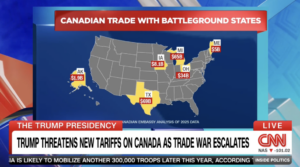
- CNN’s DANA BASH: The dramatic collapse of U.S. Canadian tariff talks is spurring a full-out trade war. And President Trump’s control of the Senate may be a casualty […]
- Here’s the thing. The six toss-up states that will determine control of the U.S. Senate do rely on trade with America’s northern neighbor. Michigan, for example. Look at that. It shares a border and totaled $65 billion in trade with Canada just last year. A lot of that from the auto industry.
- Then look at Ohio, which boasted a $34 billion trade relationship with Canada last year, making Canada by far its top export partner.
- And of course there is Maine, where the total exports to Canada are higher than the next 16 foreign markets combined.
MS NOW: Trump Admin Picks New Trade Fight with Canada
- MS NOW’s ALICIA MENENDEZ: Are the political people nervous?
- MS NOW’s LAURA BARRON-LOPEZ: I think that they’ve been nervous. I mean, so many of them have talked about how – whether it’s the previous tariffs, which now the president is trying to rebuild his tariff agenda after the Supreme Court said no – but also you put this all together, right? Because it’s not happening in a vacuum. […] All together, it’s hurting Republicans heading into the midterms.
CNN: U.S.-Canada Talks Collapse; Canada to Impose Counter-Tariffs Sept. 8

- CNN’s JOHN BERMAN: I’ll just read you a quote from David Axelrod seconds ago, posted on social media. Axe writes: ‘If you’re Leader John Thune, hoping to save your GOP Senate majority this fall, the new trade war with Canada is a nightmare. Four battleground states – Maine, Michigan, Ohio, and Alaska – could face disproportionate economic pain as a result of the tariffs.’
- So, you know, if you’re Susan Collins sitting in Maine, if you’re Mike Rogers running in Michigan, how do you feel about this this morning?
- CNN’s ZOLAN KANNO-YOUNGS: Yeah, likely nervous, right? That’s what Axelrod is trying to articulate.
Semafor: Canada tariffs complicate Republicans’ Senate defense
- President Donald Trump’s escalating tariff threats against Canada are running headlong into one of his party’s top priorities: retaining Senate control.
- The new levies could have an outsized effect in three states that could determine the Senate majority next year: Maine, Michigan, and New Hampshire.
- [Susan Collins’] performance in her reelection bid against Democrat Troy Jackson will hinge on both the president’s popularity and cost of living, the latter of which […] could rise in her state. That’s because Maine’s goods — including lumber, blueberries, lobster, and potatoes — are often processed on the other side of the border.
- Vice President JD Vance, who was campaigning for Republicans in Maine on Monday, defended the levies […] He also praised Collins […]
- “Americans are paying more for everything because GOP Senate candidates have served as a rubber stamp for Trump’s chaotic tariffs at the expense of their states,” Democratic Senatorial Campaign Committee spokesperson Tommy Garcia said in a statement. “Come November, voters will hold them accountable for making life more expensive.”
The Hill: Trump’s tariff war with Canada threatens GOP candidates in border battlegrounds
- President Trump’s tariff war with Canada is putting vulnerable GOP candidates in border states in a precarious position about 10 weeks out from the midterms, with economic anxiety already running high.
- Some strategists say the impact on Americans, particularly in states with close economic ties to Canada, will only compound GOP challenges around affordability, with voters losing trust in Republicans to handle the economy.
- “This escalation and the timing of it are problematic,” Jason Cable Roe, a Michigan-based Republican strategist, told The Hill.
- The trade war also stands to become an issue in Ohio, where Sen. Jon Husted (R ) is facing a challenge from former Sen. Sherrod Brown (D-Ohio), and in Michigan’s open Senate race between former Rep. Mike Rogers (R-Mich.) and Abdul El-Sayed. Democrats are also seeking to zero in on the issue in Iowa and Alaska, where they see opportunities to further expand the Senate map.
- The nonpartisan Cook Political Report has rated all four races as toss-ups.
- Wayne Winegarden, senior fellow in business and economics at the Pacific Research Institute, said the tariffs would make production more costly for U.S. businesses along the border, who would adjust in ways that ultimately hurt consumers and families in those states.[…] Democrats see political opportunity in the coming repercussions of the tariff tit-for-tat.
- Adrian Hemond, a Michigan-based Democratic strategist, said that Michigan, especially, and Ohio rely on trade with Canada more than other states.
- “The President’s ego may have disastrous effects for Republicans politically, but there’s no question that the economic results for Michigan and Ohio will be disastrous,” Hemond said.
- And Democratic Senate candidate and Rep. Chris Pappas (D- N.H.) is using the trade war to lash out at his Trump-backed Republican opponent, former Sen. John Sununu (R-N.H.).
- “Trump creates a mess he can’t clean up. Once again,” Pappas wrote on social media on Saturday. “John Sununu won’t speak out against it. Once again.” “Working families are paying for this recklessness,” he added. The Cook Political Report has classified New Hampshire’s race as “lean Democratic.”
- “Those costs are at some point going to get passed down to their consumers,” said Alfredo Carrillo Obregon, a trade policy analyst at the Cato Institute. “[…] I think there’s going to be cost increases in specific sectors.”
Associated Press: Trump’s trade war with Canada could rattle economies in states with key Senate races
- President Donald Trump’s trade war with Canada is escalating as the midterm elections approach, threatening Republican efforts to address voters’ economic concerns in a year when control of the U.S. Senate hinges on states along the border between the United States and its northern neighbor.
- The dispute flared over the weekend after negotiations broke down, leading Trump to raise tariffs on $20 billion in Canadian imports. Canada plans to announce tariffs of its own on Tuesday, and the spiraling conflict could lead to higher prices and scrambled supply chains for Americans already aggravated at the president’s management of the economy.
- The issue also puts pressure on Republicans in Michigan, Ohio and Alaska, states where Canada is an important trading partner. Many Democrats seem eager to capitalize on the matter as they try to regain the Senate majority […]
- “Trump is escalating a trade war with Canada for his own vanity,” Michigan’s Democratic nominee Abdul El-Sayed said on social media, adding that his Republican opponent, former Rep. Mike Rogers, is a “rubber stamp” for such policies. A third of the state’s exports go north of the border.
- Marc Short, a top adviser to then-Vice President Mike Pence during the first Trump presidency […]I think if you’re representing agricultural states, especially, your voters are probably anxious to have somebody representing their interests in Washington right now.”
- [Troy] Jackson, a logger before going into politics, said tariffs are another example of how Collins does not do enough to stand up to the president.
- “Troy spent most of his life working along the Canadian border, so he knows how important this relationship is to Maine’s economy,” Jackson spokesman Dan Gottlieb said.
- Republicans are trying to defend Senate control
- Trump made no secret of his affection for tariffs during his comeback campaign, promising that higher taxes on imports would generate a windfall for the U.S. Treasury and boost domestic manufacturing. But concerns about inflation and affordability have not receded, including in states with key races this year.
- Maine, Ohio, Michigan and Alaska boast industries including fisheries, auto parts, lumber and produce that export items across the northern border, while Canadian imports are sold by a range of U.S. retailers.
- Iowa, which also has a competitive Senate race, does not border Canada or its waters, but also exports more goods to Canada than any other nation.
- Majority Forward, a political action committee tied to Senate Democrats, already ran television advertisements against Republican Sen. Dan Sullivan of Alaska during last year’s partial government shutdown.
- “The tariffs are hitting Alaska the hardest,” the ad said. “Call Dan Sullivan and tell him […] stop raising our costs.”
- Former Ohio Sen. Sherrod Brown is trying to return to Washington by unseating Republican Sen. Jon Husted. Brown has long been a union-friendly protectionist Democrat. But he’s argued against Trump’s approach, saying it’s one thing to get aggressive with an adversarial economic powerhouse like China but another to impose uneven, unpredictable tariffs on neighboring nations.
- Husted […] embraced the White House’s economic policies, recently appearing with Vance at an Ohio steel plant to praise the administration’s economic agenda. “Today is a new day, it truly is,” Husted said. “It’s a new day because of the ‘America First’ agenda.”
- Brown has not yet criticized Husted on Canadian tariffs, concentrating instead on the senator’s support for data centers and Trump’s war with Iran. But Senate Majority PAC spokeswoman Lauren French said the Canada tariffs fight fits seamlessly into the broader case that Brown and other Democrats are making about Trump and his allies.
- “It’s another proof point for the argument that this is a guy who continues to raise your costs for no reason at all,” she said.
Washington Post: As U.S.-Canada tensions escalate, Republicans could face political consequences
- The collapse of a trade deal between the United States and Canada over the weekend, followed by President Donald Trump’s announcement Monday that he would impose even more tariffs on Canadian goods, added a new shock to midterm elections already dominated by price concerns.
- States that depend on international trade, including Maine, Michigan and Iowa, are among those at the forefront of the midterm battleground map.
- The threat of higher prices on consumer goods including gasoline, automobiles and hockey sticks gave fresh life to Democratic arguments that Trump is destabilizing the economy.
- With control of Congress at stake in this fall’s elections, Vice President JD Vance defended the mounting Canadian trade war Monday during a visit to Maine, which shares a border and economic ties with the northern nation.
- Some who watched Vance said they didn’t realize that trade talks between the U.S. and Canada had collapsed Friday, which triggered a tit-for-tat of U.S. tariffs and retaliatory actions from Canada on Saturday. On Monday, Trump took it further and said he would impose stiff tariffs on Canadian goods such as cars and steel as of Jan. 1.
- [Republican] cuts to federal spending and the federal work force hurt states where government is a major part of the economy such as Virginia, Maryland and California. The war in Iran has driven up oil prices, while tariffs have been blamed for increased costs on a vast array of consumer goods and for hurting U.S. farmers.
- News of the escalating tiff with Canada hit especially hard in Michigan, where the auto industry has operated freely across the border for more than a century.
- John Sellek, who represents a coalition of 17 Michigan business groups in the automotive, tourism and agriculture sectors that all oppose Trump’s tariffs on Canada, predicted the trade war would affect elections.
- “Most all of our members voted for President Trump, they’re not opposed to President Trump,” Sellek said. But Canada is their biggest trading partner and the tariffs are hurting their businesses and increasing costs, he said.
- Shawn Fain, president of the United Auto Workers union, a key mobilizing force for the Democratic Party in Michigan, condemned any escalation “on Canada, a country with strong unions and labor standards” in a statement on Monday.
- Charles Wade, a United Auto Workers representative at a Ford factory in Wayne, Michigan, […] worries that any new trade levies on the sector will impact union jobs. “Those Canadian auto workers are union [members] as well,” Wade said. “An attack on one is an attack on all.”
- The issue of affordability helped Democrats run up wins in off-year elections in 2025, and this year they are campaigning heavily on the theme in congressional midterms.
- Polling hints at the potential political consequences. In May, a Marquette Law School national poll found 67 percent disapproved of Trump’s handling of tariffs, with a similar share who disapproved of his handling of the economy overall.
- An April poll by the University of Calgary and Ipsos found more than twice as many Americans opposed tariffs on Canadian goods as supported them.
- A Washington Post-Ipsos poll in July found 43 percent of voters saying they were “not as well off” as when Trump returned to office last year, which is among the highest saying this about any recent president and similar to the share who said this about President Joe Biden in 2023-24.
Washington Examiner: Canada trade war puts border state Republicans on defense: ‘Not helpful’
- A renewed trade war with Canada is bleeding into the midterm elections as Democrats use the economic volatility to woo voters concerned about the cost of living this fall.
- Democrats are highlighting what they label as the “devastating” impact of tariffs President Donald Trump imposed after trade negotiations with Canada fell apart over the weekend.
- Those warnings are loudest in border states that could decide the balance of power on Capitol Hill, including Michigan, Ohio, and Maine, where Democrats are targeting vulnerable incumbents and their voting records in Congress.
- The tariff criticism from Democrats is part of a larger strategy tapping into voter anxieties about the economy […]
- The war in Iran and its impact on gas prices is also a pillar of that messaging, as polls show Trump’s approval ratings on the economy, normally a point of strength for Republicans, declining since the conflict began in late February.
- […] the timing of the latest duties, occurring little more than two months before the midterm elections, has some Republicans viewing the trade spat as an unforced error that could turn off voters in the states most reliant on Canadian trade.
- Jason Roe, a GOP operative in Michigan politics, said the “erratic” way the tariffs have been leveled against one of the U.S.’s biggest trading partners is “problematic for business and farming, and undermines our arguments on cost of living issues.”
- It could also affect states such as Alaska, where Sen. Dan Sullivan (R-AK) is running in a toss-up race for Senate.
- One of the latest attacks from Democrats came Monday, when ex-Sen. Sherrod Brown, the Democratic nominee for Senate in Ohio, released an ad blaming incumbent Sen. Jon Husted (R-OH) for the “out of control” cost of gasoline and fertilizer.
CNN: Trump’s theory of global power faces a reckoning in Iran and Canada
- A long tariff duel could result in the mutually assured destruction of the auto industry on both sides of the border. And the growing impact of Canadian boycotts could weaken Republicans in key contests in border states Michigan and Maine, which could decide who controls the US Senate next year.
Latest News
VICTORY LAP: Democratic Senators-Elect Take to the Airwaves in Post-Midterm Blitz
VICTORY LAP: Democratic Senators-Elect Take to the Airwaves in Post-Midterm Blitz

